Consulting Services for Small Businesses
NACVA Business Valuation Guidelines
The National Association of Certified Valuators and Analysts (NACVA) provides a comprehensive framework to ensure business valuations are credible, consistent, and defensible. Its standards guide valuators in defining the scope of work, applying appropriate methodologies, and presenting transparent conclusions.
Every engagement begins with clearly establishing key parameters, including the standard of value (such as fair market value), premise of value (going concern or liquidation), valuation date, and intended use of the report. These elements form the foundation for all subsequent analysis.
NACVA emphasizes the use of reliable and relevant data, requiring a thorough review of financial statements, operational information, and industry conditions. A critical step is the normalization of financials, where adjustments are made for non-recurring items, discretionary expenses, and owner compensation to reflect the true economic performance of the business.
Three primary valuation approaches must be considered: the Income Approach, Market Approach, and Asset Approach. The valuator must assess the applicability of each and clearly document the rationale for selecting or excluding methods.
Professional objectivity is central to NACVA standards. Valuators are expected to apply independent judgment, exercise professional skepticism, and ensure that key assumptions—such as growth rates and discount rates—are reasonable and supportable.
NACVA distinguishes between a Conclusion of Value, which involves comprehensive procedures, and a Calculation of Value, which is more limited in scope.
Finally, reports must be clear, transparent, and well-documented, including methodologies, assumptions, and any limiting conditions, ensuring the valuation can withstand scrutiny.

Consulting Services for Small Businesses
Balanced Scorecard Approach to Strategy
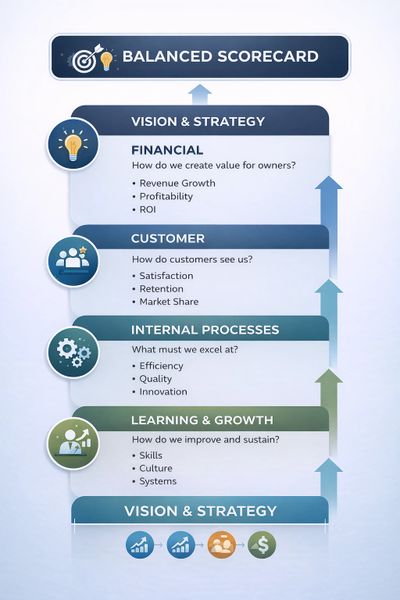
The Balanced Scorecard, developed by Robert S. Kaplan and David P. Norton, is a strategic management framework that translates an organization’s vision and strategy into a coherent set of performance measures.
Rather than relying solely on financial metrics, the Balanced Scorecard evaluates performance across four integrated perspectives: financial, customer, internal processes, and learning and growth. This ensures that short-term financial outcomes are balanced with the drivers of long-term value creation.
The framework begins with clearly defined strategic objectives, which are then mapped across these perspectives to show cause-and-effect relationships. For example, improvements in employee capabilities (learning and growth) enhance operational efficiency (internal processes), leading to better customer outcomes and ultimately stronger financial performance.
A key strength of the Balanced Scorecard is its ability to align the organization. By linking high-level strategy to departmental and individual objectives, it ensures that all parts of the business are working toward common goals. It also provides a structured basis for setting targets, monitoring progress, and driving accountability.
Importantly, the Balanced Scorecard is not just a measurement tool—it is a strategy execution system. It enables organizations to communicate priorities clearly, track performance consistently, and adapt strategies based on real-time insights.
In essence, the Balanced Scorecard helps organizations move from strategy formulation to disciplined execution, ensuring that vision is translated into measurable and sustainable results.
Consulting Services for Small Businesses
Blue Ocean Strategy
Blue Ocean Strategy, developed by W. Chan Kim and Renée Mauborgne, is a strategic framework that focuses on creating new market space rather than competing in existing, saturated industries. It shifts the emphasis from outperforming competitors to making competition irrelevant by unlocking new demand.
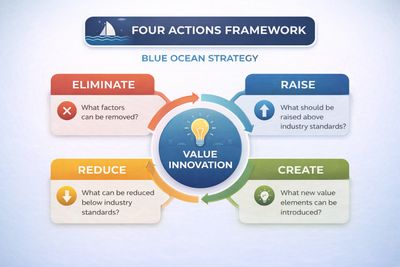
The approach is built on the concept of value innovation, where companies simultaneously pursue differentiation and low cost. Instead of choosing between offering superior value or achieving cost efficiency, organizations redesign their value proposition to deliver both. This is achieved by eliminating and reducing factors that add cost without meaningful customer benefit, while raising and creating elements that enhance value.
A central tool within the framework is the Four Actions Framework, which guides businesses to systematically rethink industry assumptions by asking what to eliminate, reduce, raise, and create. Supporting this is the strategy canvas, which helps visualize current competitive positioning and identify opportunities for differentiation.
Blue Ocean Strategy encourages companies to look beyond existing customers and target non-customers, thereby expanding the market rather than competing within it.
Ultimately, it is a disciplined approach to innovation that enables organizations to achieve sustainable growth by redefining industry boundaries and delivering unique value propositions.
Consulting Services for Small Businesses
OKR Methodology
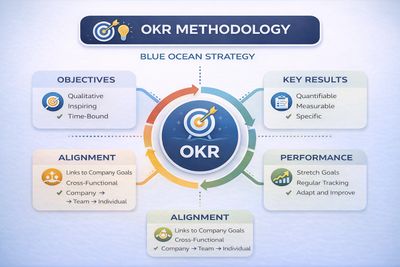
The Objectives and Key Results (OKR) methodology is a goal-setting framework that aligns organizational priorities with measurable outcomes. Popularized by Andy Grove and later adopted by companies like Google, OKRs are designed to drive focus, accountability, and execution.
The framework consists of two core components: Objectives and Key Results. Objectives define what the organization aims to achieve and are typically qualitative, ambitious, and time-bound. Key Results are specific, measurable indicators used to track progress toward each objective. Together, they ensure that goals are both inspiring and actionable.
A key strength of OKRs is their emphasis on alignment and transparency. Objectives are cascaded across the organization, linking company-wide priorities to team and individual goals. This creates clarity on what matters most and ensures that efforts are coordinated toward shared outcomes.
OKRs also promote a culture of stretch performance and continuous improvement. Targets are often set aggressively, encouraging innovation and progress beyond incremental gains. Regular check-ins and reviews enable organizations to monitor performance, adapt quickly, and learn from results.
Importantly, OKRs are not a performance evaluation tool but a management system for execution, helping organizations translate strategy into measurable, high-impact results.